

When I received an email through the alumni network of the EU Children’s Participation Platform, inviting me to participate in the EU Youth Policy Dialogue on the Digital Fairness Act, I immediately knew that I wanted to take part.
The dialogue, which took place on 18 June 2026 in Ljubljana, Slovenia, brought together 28 young people from across the European Union and the Western Balkans to exchange ideas directly with European Commissioner Michael McGrath.
The event was to place young people’s experiences at the centre of discussions on the upcoming Digital Fairness Act, which aims to create a fairer and safer online environment, particularly for children and young people.
My personal preparation and research
Although digital fairness is not a topic that I work on every day, it is something that concerns everyone. Whether you are a child, a teenager or an adult, almost everyone uses digital platforms daily and whatever comes out of this Act will affect almost every one of us as EU citizens.
Therefore, I was very happy to be selected to participate. I also genuinely felt that I had something valuable to contribute, because I already had considerable experience in youth participation at EU level and had many thoughts and opinions about the topics that would be discussed.
Before travelling to Slovenia, participants were asked to choose the discussion topic that interested them the most. I chose influencer marketing, because I find it fascinating how online creators influence young people’s choices every day, including mine from time to time!
However, I also wanted to contribute to the discussions on all the other topics. To prepare myself, I decided to do my research in a different way to only reading reports or academic articles.
I searched for videos on TikTok on topics such as age restrictions on social media and spent a lot of time reading the comments sections. I wanted to understand what ordinary young people actually thought about these issues.
| "Not every young person can sit around the table with policymakers, but through listening to their conversations online, I felt I could bring a small part of their voice into the room. During the dialogue, I also explained that this was part of my preparation, because it was important to bring those perspectives into the room." |
Dialogue day 1: youth discussions
The first day focused on preparation and group discussions. We discussed a wide range of topics that would later be presented to European Commissioner Michael McGrath, including dark patterns, age restrictions, limitations on certain platform features and several other aspects of digital fairness.
Although I had officially chosen influencer marketing as my main topic, I also wrote down my own opinions on all of the discussion themes because I wanted to contribute as much as possible during the dialogue.
I was immediately impressed by how passionate and open-minded everyone was. Every participant had the opportunity to share their ideas, and people genuinely listened to one another. What stood out to me most was that no one was afraid to rethink their opinion. That even happened to me. Before the dialogue, I mainly supported stricter age restrictions on social media for children.
However, after hearing different perspectives, I realised there might be a better approach. Instead of simply restricting access, an idea began to grow in my head, that child-friendly versions of social media platforms allow younger users to explore the online world in a safer, age-appropriate environment.
The discussions showed me that meaningful dialogue is not only about sharing your own ideas, but also about being open to changing them.
Dialogue day 2: discussion with Commissioner Michael McGrath
During this session, each group presented the ideas that were developed during the previous day’s conversations. My group presented our recommendations on influencer marketing, while the other groups shared their conclusions on the other topics. So, everyone’s ideas from the previous day were represented.
Each participant could also explain their ideas before engaging in a discussion with the Commissioner. We each spoke for about a minute before continuing with a broader conversation about our recommendations. Rather than simply presenting our ideas, we were able to discuss them in detail.
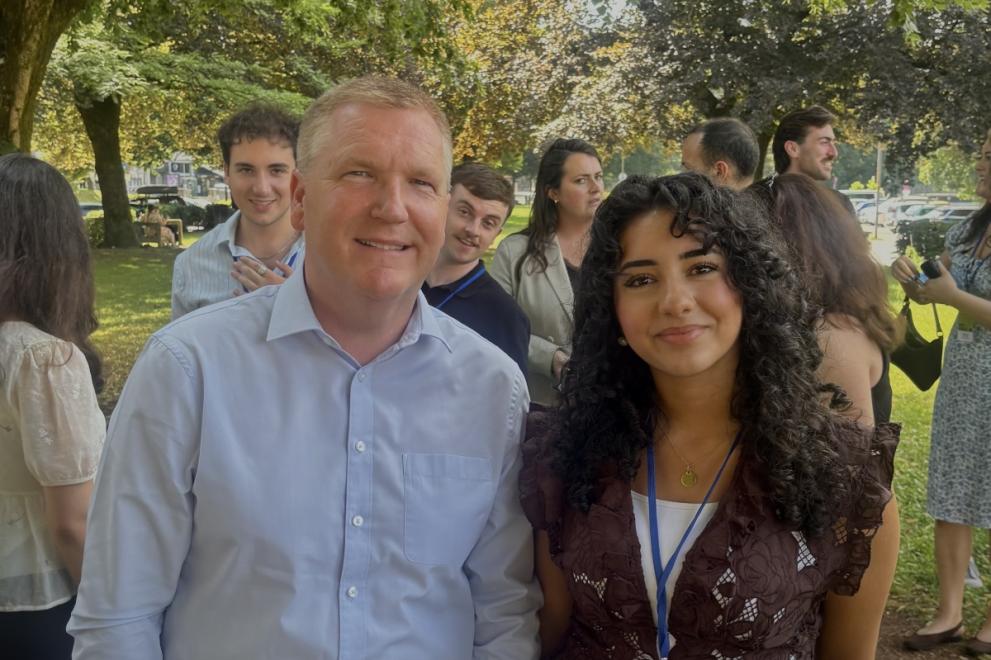
One thing that stayed with me throughout the entire experience was how genuinely interested Commissioner McGrath seemed in what we had to say.
Before the event, I expected that someone at his level would listen politely before moving on to the next meeting. Instead, he actively engaged with us. He asked follow-up questions, challenged some of our ideas, suggested alternative approaches and really took the time to understand our perspectives.
Even though he had flown in that same morning and had already been busy with other responsibilities, he never gave the impression that he was rushing through the session. He treated our ideas with respect and showed genuine curiosity about what young people had to say.
I found that particularly inspiring because it made the dialogue feel authentic rather than symbolic. It truly felt like a conversation instead of a presentation.
Some final reflections
Looking back, this experience also changed my own perspective. Besides changing my opinion on age restrictions, I also learned much more about how the European Union is already working on creating a fairer digital environment while still respecting people’s privacy.
We learned more about ideas such as an EU-wide age verification system that could verify a person’s age without unnecessarily sharing personal information. I found it very interesting to see how policymakers are trying to balance children’s safety with fundamental rights such as privacy.
Overall, participating in the EU Youth Policy Dialogue confirmed that young people can genuinely contribute to European policymaking.
It also reminded me that the best ideas often come from listening to others, being open to changing your own perspective and making sure that the voices of ordinary young people are represented in important discussions.
The experience left me with one lasting thought: Young people are often described as the future, but when it comes to digital policy, we are very much the present too.
About Naya
Naya is an ambassador with Save the Children, a member of the Youth Board of Missing Children Europe and has been involved with the Platform since 2022. She cares that children’s voices are heard, especially on topics like discrimination, inclusion, and children with a refugee background.